


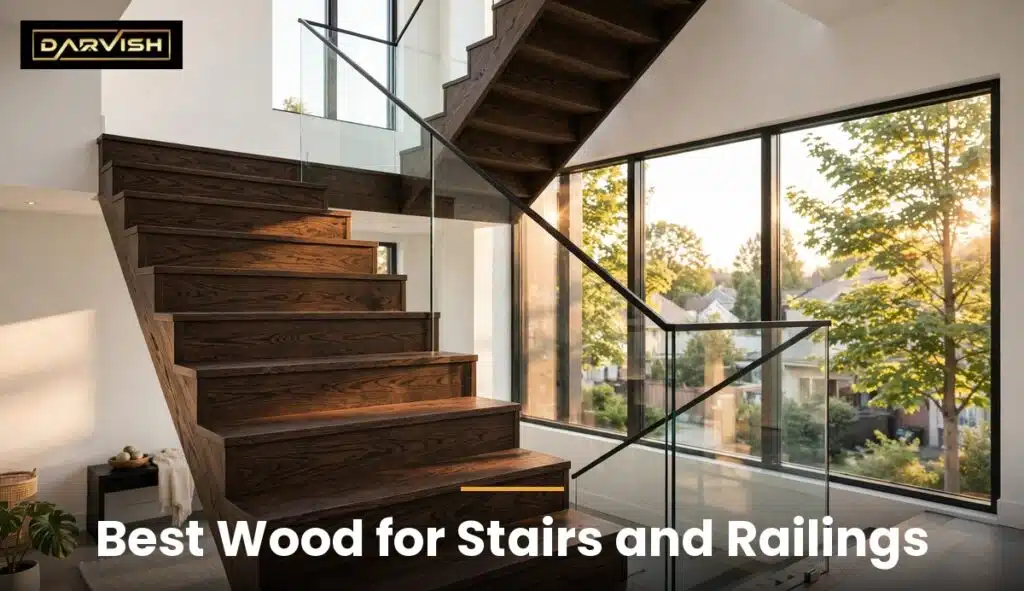
Choosing the best wood for stairs is one of the most important decisions in any staircase project. The wood you pick decides how your stairs look on day one, how they handle thousands of footsteps year after year, and how much care they need along the way. A soft wood dents under heels, furniture and pet claws. A hard, stable wood stays smooth, holds its finish and ages gracefully. This guide compares the most popular woods for stair treads, risers and handrails — oak, maple, walnut, ash, cherry, mahogany, pine and more — by hardness, tone, durability and cost, so you can choose the best wood for stairs and treads, and the best wood for stair railing, with confidence for your Toronto home.
We also cover which woods hold up outdoors through a Toronto winter, which ones suit a busy family staircase, and how Darvish Inc approaches wood stairs and railings across the GTA.
LAST UPDATED: November 14, 2026
In this guide:
- What Makes a Wood Good for Stairs and Railings
- The Best Woods for Stairs and Railings Compared
- The Best Wood for Railings and Handrails
- Indoor or Outdoor: Which Woods Hold Up in Toronto
- How to Choose the Right Wood: Longevity, Tone and Budget
- Caring for Wooden Stairs and Railings
- How Darvish Inc Approaches Wood Stairs and Railings
- The Right Wood for Your Stairs
- Frequently Asked Questions
What Makes a Wood Good for Stairs and Railings
A staircase is not a piece of furniture. It takes impact every day: shoes, boots, dropped keys, moving boxes, pets running up and down. Four qualities decide whether a wood survives that life or shows every mark within a year.
First is hardness. The industry measures it with the Janka test, which presses a steel ball into the wood and records the force needed. The higher the number, the harder the wood resists dents and scratches. For stairs, anything above roughly 1,200 lbf is a safe, hard-wearing choice; below 1,000 lbf, you will see heel marks sooner. Janka figures are published for every common species, and the table below uses them.
Second is stability. Toronto homes swing between dry, heated winters and humid summers, and wood moves with that moisture. A species that shrinks and swells a lot can open gaps at the joints or cup across a wide tread. Quarter-sawn boards and well dried lumber help, but the species itself sets the baseline.
Third is grain and tone. A staircase is the visual centre of many homes, so the wood has to look right as well as perform. Open-grained oak takes stain beautifully and hides scuffs. Tight-grained maple looks clean and modern but shows marks more easily. Dark walnut and cherry bring warmth, while pale ash keeps a room bright.
Fourth is rot resistance, which matters the moment a staircase or railing steps outside. Indoor stairs never face rain or snow, so almost any hardwood works. Outdoor stairs need a wood that resists moisture and decay, or a finish schedule that protects it. That matters twice on a wooden railing, where the handrail is touched every day and the balusters take knocks from bags and toys.
The Best Woods for Stairs and Railings Compared
The table below puts the ten woods side by side, with hardness figures from The Wood Database. Cost is shown as a relative level — Budget, Mid-range or Premium — because lumber prices move with the market and Darvish Inc quotes each project individually. Use it to shortlist woods for your own stairs before you talk to an installer.
| Wood | Janka hardness | Best for | Tone | Cost level |
|---|---|---|---|---|
| White oak | 1,350 lbf | Treads, handrails, outdoor steps | Warm brown, strong grain | Mid-range |
| Red oak | 1,220 lbf | Treads, handrails, staining | Pinkish brown, open grain | Budget |
| Hard maple | 1,450 lbf | High-traffic treads | Pale cream, fine grain | Mid-range |
| White ash | 1,320 lbf | Treads, curved handrails | Light brown, bold grain | Budget |
| Black walnut | 1,010 lbf | Statement treads, handrails | Dark chocolate brown | Premium |
| Brazilian cherry (jatoba) | 2,690 lbf | Hardest-wearing treads | Rich reddish brown | Premium |
| American cherry | 950 lbf | Handrails, formal stairs | Warm reddish brown | Premium |
| Mahogany | 900 lbf | Handrails, classic stairs | Deep reddish brown | Premium |
| Yellow pine | 690–870 lbf | Budget treads, painted stairs | Pale yellow, knots | Budget |
| Western red cedar | 350 lbf | Covered outdoor steps, decks, balconies | Reddish brown, straight grain | Budget |
The everyday winners: oak, maple and ash
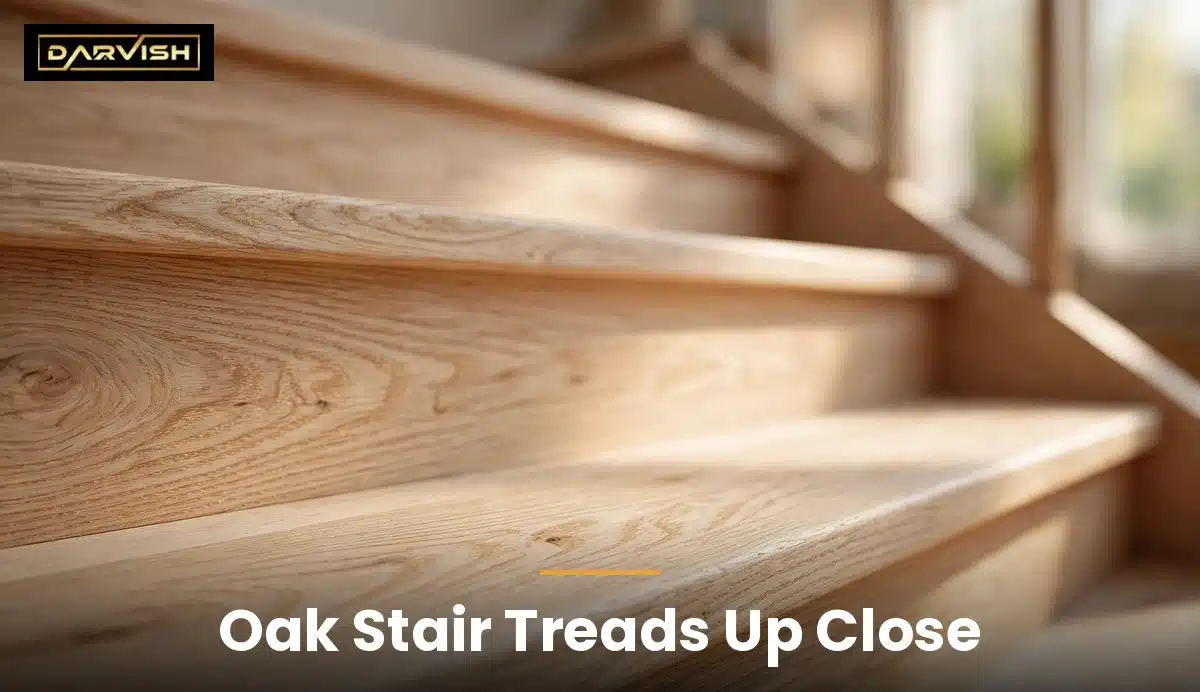
If you want the safest answer, start here. White oak is the best all-round choice for stairs in most Toronto homes: hard enough at 1,350 lbf to shrug off daily wear, naturally resistant to moisture thanks to its closed pores, and warm enough to suit both traditional and modern interiors. It also stains evenly, so it can go light, dark or natural. Red oak is its close cousin — a little softer at 1,220 lbf and a little cheaper — with a pinker tone and an open grain that drinks in stain. Hard maple is the hardest of the three at 1,450 lbf and the palest, which makes it a favourite for bright, contemporary staircases, though its fine grain shows scuffs sooner than oak.
If your priority is the handrail itself, the best wood for stair railing is usually the same species as your treads — matching them looks deliberate and wears evenly. That said, mixing is fine too: a walnut handrail on oak treads is a popular combination, and both approaches work — the choice comes down to taste. White ash, at 1,320 lbf, is the value pick: strong, light in colour, with a bold grain that hides small marks, and it bends well, which makes it a good choice for a curved wooden railing. For a busy family staircase, the best wood for stairs is usually the hardest one you can afford in a tone you love.
The rich and dark: walnut, cherry and mahogany
These are the woods you choose when the staircase is a feature, not just a way upstairs. Black walnut is one of the darkest North American hardwoods, a deep chocolate brown with a straight, elegant grain. At 1,010 lbf it is softer than oak, so it suits a formal staircase or a handrail more than the busiest family treads — but nothing else looks quite like it. American cherry starts a warm reddish brown and deepens with age and light, which many homeowners love; at 950 lbf it needs a little more care, and it rewards a handrail or a lower-traffic stair.
Mahogany has the same classic, deep-red character at 900 lbf, and it has been the traditional choice for grand staircases for generations. All three sit in the premium range, and all three are best finished with a clear coat that shows the grain rather than a stain that hides it. A wooden railing in walnut or cherry is the centrepiece of a formal staircase, and it is worth choosing the species for the handrail first, then matching the treads to it.
The hardest of all: Brazilian cherry (jatoba)
Brazilian cherry, sold as jatoba, is in a class of its own for hardness: 2,690 lbf, roughly double white oak. If your staircase carries heavy daily traffic, pets, or a rental unit, it is the most dent-proof wood on this list. Its colour is a rich reddish brown that deepens over time, and it takes a beautiful polish. The trade-off is workability — it is heavy and hard on tools — and price, which sits at the premium end. For most homes it is more wood than the stairs need, but for a staircase that must look new after ten hard years, it is the strongest argument on the table.
The budget and outdoor picks: yellow pine and cedar
Yellow pine and cedar are softwoods, so they dent more easily than any hardwood here — that is the honest trade-off for their price. Yellow pine is the budget workhorse: pale, knotty, easy to paint, and a sensible choice for a painted staircase, a basement stair or a rental property where cost matters more than a showpiece finish. Cedar is the outdoor member of the pair: naturally resistant to decay, light in weight, and a good fit for covered outdoor steps, decks and balconies — the same outdoor pick as in our wood railing cost guide — though it needs oiling once a year outside or it turns silver-grey.
For a covered back step, cedar is a fair candidate for the best wood for outdoor stairs on a budget, and the best lumber for outdoor steps when cost is the deciding factor. Pressure-treated lumber is the cheapest outdoor option of all: pine treated against rot and insects, widely available in Ontario, though it is a utility choice that suits a back step more than a showpiece staircase. Neither is the right pick for a main staircase in a busy family home, but both have a clear place where budget or weather is the deciding factor.
The Best Wood for Railings and Handrails
Choosing the best wood for stairs and railings starts with the hand, not the tread: a handrail is touched every day, so feel and stability matter more than hardness alone. For grip, fine-grained woods like maple and cherry feel smoother under the hand than open-grained oak, and they take a clear finish that stays comfortable to hold. For stability, the best wood for stair railing is one that holds screws and joints without splitting — oak and maple are the reliable choices here, while a softwood handrail can loosen over time.
For a painted railing, poplar is the sensible pick: it is smooth, takes paint beautifully and costs less than a hardwood, which is why it is the budget choice in our wood railing cost guide. Whatever the species, sand the handrail smooth and finish it on all sides, because an unfinished edge is the first thing a hand notices.
Indoor or Outdoor: Which Woods Hold Up in Toronto
Indoor and outdoor stairs live in different worlds, and the best wood for outdoor stairs is not always the best wood indoors. Inside, the enemy is wear — heels, claws, furniture — so hardness leads the choice and almost any hardwood on the table above will serve. Outside, the enemy is water. Rain, snow, freeze-thaw cycles and summer sun attack the wood itself, and a species that is fine indoors can fail outdoors within a few seasons.
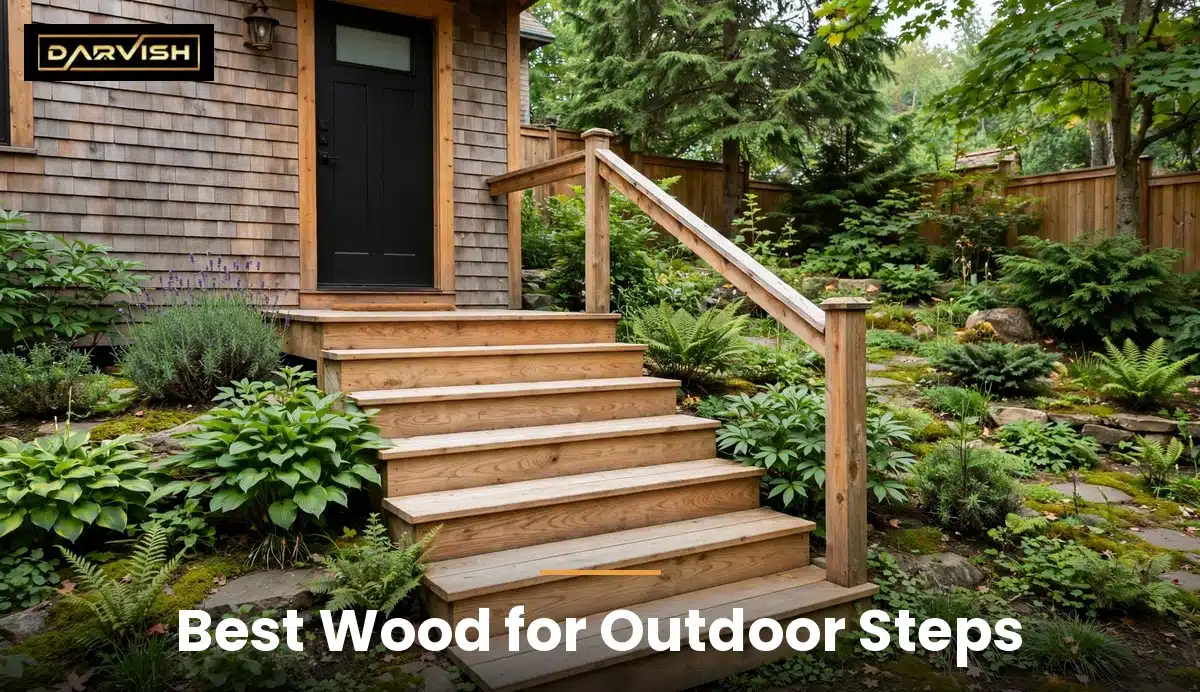
For outdoor steps, start with rot resistance and stability, then check hardness. When homeowners search for the best lumber for outdoor steps, they usually mean one thing: a wood that will not rot, warp or split after one Toronto winter. White oak is the standout: its closed pores block moisture, it holds up to freeze-thaw, and at 1,350 lbf it is hard enough for daily use.
If you are comparing the best lumber for outdoor steps, white oak, hard maple and white ash are the three names to shortlist, with white oak first for exposed locations and cedar, maple or ash for covered porches. Red oak looks similar to white oak but its open pores absorb water, so it belongs indoors unless it is fully sealed and sheltered. Brazilian cherry also performs well outside thanks to its density, though its premium price is hard to justify for a back step.
A practical rule for Toronto: fully exposed outdoor steps should be white oak, jatoba or a properly sealed hardwood; covered porch steps can use cedar, ash or maple; and any outdoor wood stair needs a finish that is maintained — oil or exterior polyurethane, recoated before the surface greys. For the lowest budget, pressure-treated lumber is the cheapest outdoor option. The same thinking applies to outdoor railings: choose a species that resists rot, keep the end grain sealed, and never let water sit on a flat handrail. The same logic applies to basement stairs ideas — a basement stair is usually indoors and low-traffic, so a mid-range hardwood is often enough.
How to Choose the Right Wood: Longevity, Tone and Budget
Choosing well means weighing three things together: how long the wood lasts, how it looks, and what it costs.
Longevity and density
Longevity is the most important factor to consider when choosing a wood type, and density is its best predictor. The denser and harder the wood, the longer it lasts underfoot: hard maple, white oak and ash will outlast cherry, mahogany and pine on the same staircase. But density is not the whole story — a well-finished softer wood on a low-traffic stair can outlive a hard wood that was installed green or finished badly. Ask your installer how the lumber was dried and how the treads are fixed; a stable, well-installed staircase in a mid-range wood beats a premium species installed poorly.
For a busy household with children or pets, choose from the top of the hardness table and accept the higher material cost — it is cheaper than refinishing early. In short, when you weigh longevity against tone and budget, the best wood for stairs is the one that scores well on all three — not just the hardest or the cheapest.
Tone and texture
If you care about how the staircase looks — and most homeowners do — tone and texture deserve the same weight as hardness. Mahogany, Brazilian cherry, American cherry and red oak are your best bets for warmth and character: they carry colour and pattern that age well and make the staircase a feature. Pale woods — hard maple, white ash, yellow pine — keep a room bright and suit a modern, minimal interior, but they show dirt and scuffs sooner, so they ask for a little more cleaning. One more tip: take a sample home. A board that looks perfect in a showroom can read very differently under your own lighting, next to your floor and your wall colour. Live with the sample for a few days before you commit.
What shapes the cost
For most people, the decision comes down to cost, and three things shape it: the species, the grade and the size of the job. Exotic and dark woods like mahogany and Brazilian cherry cost more than plain yellow pine and ash. White oak sits in the middle, red oak at the budget end and American cherry at the premium end — so you can still get a bit of colour for a reasonable price. Grade matters too: clear, knot-free boards cost more than boards with knots or colour variation, and wide treads cost more per piece than narrow ones. Labour is the third piece — a hardwood that is hard to cut and fasten takes longer to install.
Darvish Inc quotes every wood staircase individually, so the honest way to compare is a written quote for your exact staircase, not a generic price per foot. For a sense of the numbers, see our breakdown of wood railing cost in Toronto before you request a quote.
Caring for Wooden Stairs and Railings
The best wood for stairs still needs care. Dust and grit act like sandpaper under shoes, so a quick sweep or vacuum once a week protects the finish more than any product. Wipe spills promptly, use a damp — not wet — cloth for cleaning, and avoid harsh chemicals that strip the finish. Every few years, a high-traffic staircase benefits from a light screen and recoat, which restores the surface without a full sanding. Our guide to how to clean wooden stairs walks through the routine step by step, including which cleaners are safe on an oiled or polyurethane finish. With that simple routine, a hardwood staircase keeps its finish and stays smooth underfoot. A wooden railing benefits from the same routine: wipe the handrail down, check the finish where hands grip it most, and recoat before the surface dulls.
How Darvish Inc Approaches Wood Stairs and Railings
Darvish Inc installs custom staircases and wood stair railings across Toronto and the GTA, and the wood choice is part of our first conversation, not an afterthought. The team looks at how the staircase will be used, whether it sits indoors or outdoors, what the rest of the home looks like, and what budget the project has — then recommends the best wood for stair railing and treads for your project, with samples you can hold before you decide. Every wood staircase is measured and installed by our own team, so the species, the finish and the fit are all handled in one place. You can see our recent work and reviews on Google, and request a free quote for your own staircase.

The Right Wood for Your Stairs
There is no single perfect wood for every home or staircase — the best wood for stairs is the one that fits how you live, where the staircase sits, and what you want to spend. For most Toronto homes, white oak is the answer that balances hardness, moisture resistance, tone and price. For fully exposed steps, the best lumber for outdoor steps is white oak or jatoba, and the best wood for stairs indoors is the hardest one you love the look of.
Hard maple and ash are close behind for bright, modern stairs; walnut, cherry and mahogany are the choice when the staircase is a showpiece; and Brazilian cherry is the answer when nothing less than the hardest-wearing tread will do. Whatever you choose, compare the table, ask for samples, get it installed properly, and keep up the finish — and the staircase will stay looking good for years.
Frequently Asked Questions
▾
What is the best wood for stairs?
White oak is the best all-round choice for most Toronto homes: at 1,350 lbf on the Janka scale it resists dents, its closed pores resist moisture, and its warm tone suits both traditional and modern interiors. Hard maple (1,450 lbf) is harder still and suits bright, contemporary stairs, while white ash (1,320 lbf) is the best-value hardwood. The right wood for your stairs depends on traffic, location and budget, so compare the table above before you decide. The same logic picks the best wood for stair railing: match the handrail species to your treads for a deliberate, even-wearing result.
▾
What is the best wood for outdoor stairs?
White oak is the best wood for outdoor stairs in Toronto: its closed pores block moisture, it handles freeze-thaw cycles, and at 1,350 lbf it is hard enough for daily use. Brazilian cherry also performs well outdoors thanks to its density. Red oak should stay indoors unless fully sealed and sheltered, because its open pores absorb water. Any outdoor wood stair also needs an exterior finish that is recoated before the surface greys. That is why white oak tops most shortlists of the best lumber for outdoor steps.
▾
Is oak or maple better for stair treads?
Both are excellent, and the choice comes down to look and feel. Hard maple is harder (1,450 lbf versus 1,350 lbf for white oak) and paler, so it suits a bright, modern staircase — but its fine grain shows scuffs sooner. White oak is a little softer, warmer, more moisture-resistant and easier to stain, which makes it the more forgiving choice for a busy family staircase and for any stair near an entrance.
▾
Can I use pine for stairs?
Yes, but with open eyes. Yellow pine is a softwood, so it dents more easily than any hardwood on this list and it shows wear sooner on a busy staircase. It is a sensible choice for a painted staircase, a basement stair or a rental property, where its low cost matters more than a showpiece finish. For a main staircase in a family home, a hardwood like oak, maple or ash will look better for longer and is usually the better investment.
▾
Can I mix different woods on one staircase?
Yes — mixing woods is common and can look very good when it is done deliberately. A popular combination is hardwood treads with a painted riser, or a dark walnut handrail against pale oak treads. Keep the palette to two woods at most, make sure their tones work together in your lighting, and use the harder wood on the treads, where the wear happens. For the handrail itself, choose the wood that feels best under the hand, and let the treads carry the hardest species. Your installer can show you samples of the combination before you commit.