
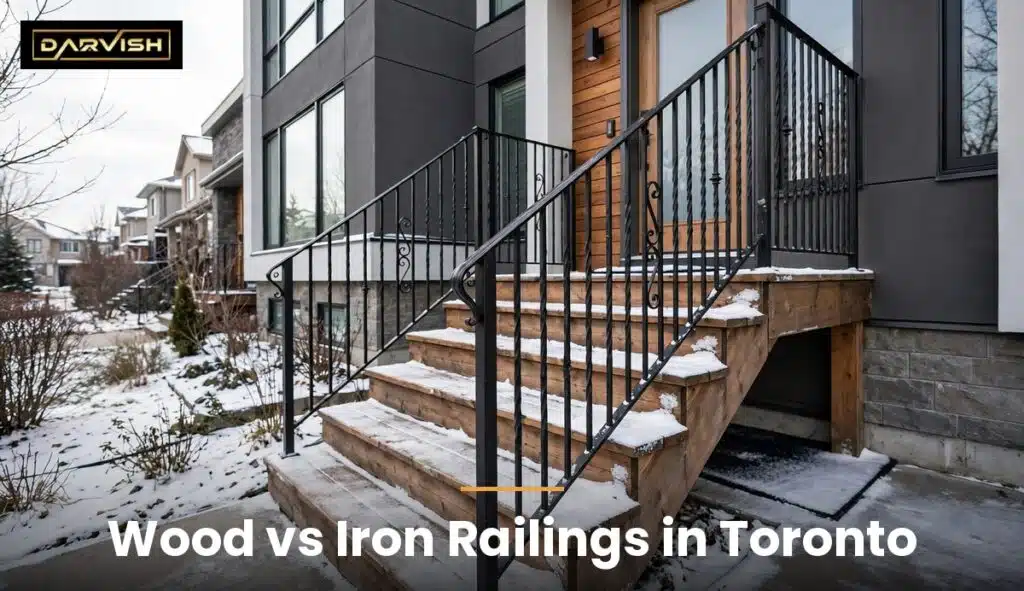
If your outdoor stairs are exposed to snow, ice, and constant freeze-thaw cycles, the wood vs iron railings decision is the one that decides whether your staircase survives the winter or starts failing by spring. Metal railings for stairs Toronto homeowners ask about most are usually the iron ones, because iron holds its shape when the temperature swings forty degrees in a week — but wood still has a place, when it is designed right, built with the right materials, and maintained every year. The best choice depends on durability expectations, maintenance tolerance, and long-term value. Let’s break it down properly, so you can make a smart, informed decision before you spend a dollar on a railing that has to survive a Toronto winter. This guide compares wood and iron side by side — durability, maintenance, safety in ice, cost over ten winters, and what the building code requires — so the choice you make is the one your staircase will still be proving right in five winters’ time.
Why Toronto’s Winters Are Hard on Outdoor Stair Railings
Outdoor stairs in Toronto and surrounding areas such as North York, Richmond Hill, Markham, Vaughan, and Oakville face some of the toughest weather conditions in Canada — and the wood vs iron railings question starts here, with what winter actually does to a railing. Outdoor stairs and railings take four kinds of punishment every winter, and each one attacks a different weakness. The outdoor stair railings in Toronto that fail first are almost always the ones that were chosen for looks alone, with no thought for what February does to them.
- Heavy snowfall and ice buildup: snow sits on the treads and the handrail for weeks, melts a little on a sunny afternoon, and refreezes overnight into a sheet of ice.
- Repeated freeze-thaw cycles that stress materials: water gets into every small crack, freezes, expands, and opens the crack a little wider — forty times a winter.
- Moisture penetration and long-term exposure: rain in November, slush in December, meltwater in March — the railing is wet for five months straight.
- De-icing salts that accelerate material deterioration: salt eats metal coatings and dries wood out at the same time, and it gets into every joint.
This is why choosing the right materials and working with professionals who understand local conditions matters far more than aesthetics alone. A railing that looks perfect in September can be a safety problem by February, and the fix is always more expensive than choosing right the first time.
Wood Railings for Outdoor Stairs in Toronto
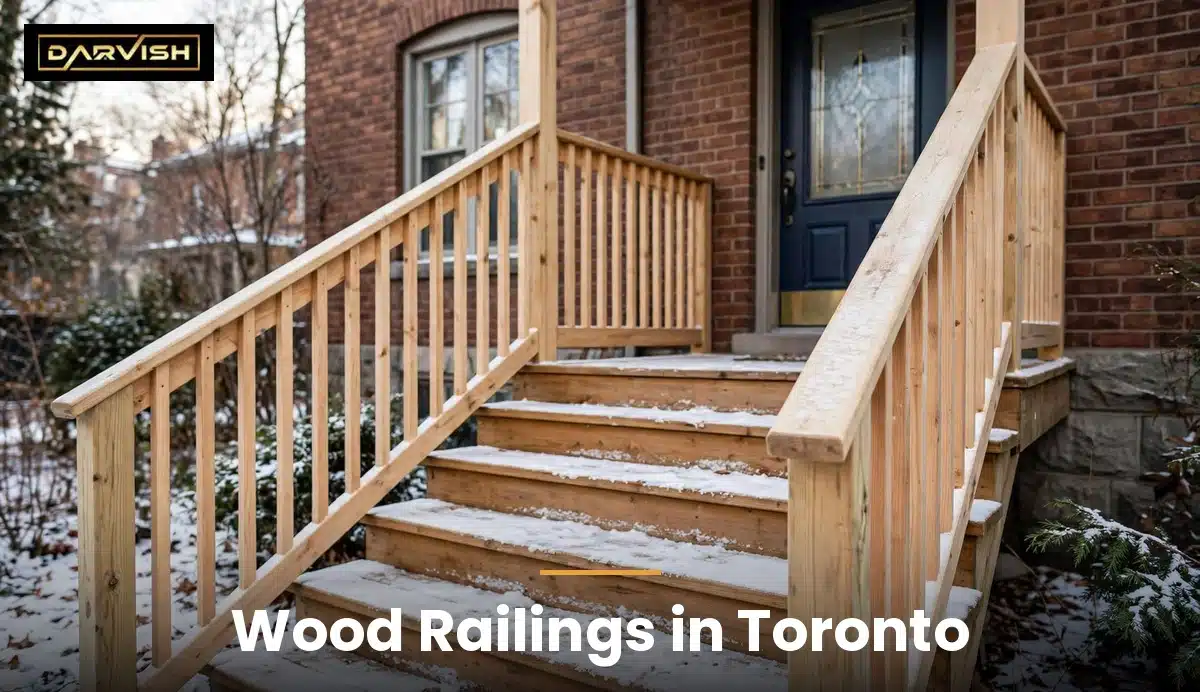
Wood railings remain popular because of their natural look and design flexibility, and the wood vs iron railings comparison has to start with what wood does well — because wood is not the wrong choice, it is the choice that asks more of you. Many homeowners choose wood railings Toronto properties commonly use for classic and transitional exteriors, and when the wood is the right species, the design is right, and the maintenance is done on schedule, a wood railing can look beautiful for years. Outdoor stairs and railings in wood feel warm in a way metal never does, and that warmth is the reason wood survives as a choice at all.
Advantages of Wood Railings
- Warm, natural appearance that enhances curb appeal: wood softens a concrete staircase and makes the entrance feel like part of the home, not part of the street.
- High customization potential for bespoke designs: wood can be shaped, carved, stained and painted in a way no metal can match, so the railing can follow the home’s style exactly.
- Easier to modify or repair: a damaged wood baluster can be replaced in an afternoon by a carpenter, with no welding and no waiting for a fabrication shop.
- Can visually connect outdoor railings with interior railings: the same wood species inside and outside makes the whole home feel like one design.
Limitations in Harsh Winters
Despite their beauty, wood railings require more care in cold climates, and this is where the comparison starts to favour iron. Wood absorbs moisture, and moisture is the enemy: it swells the wood, cracks the finish, and warps the balusters out of line.
- Susceptible to moisture absorption, cracking, and warping: once water gets under the finish, the wood moves with every freeze and thaw, and the railing slowly goes out of true.
- Requires sealing, staining, or painting on a regular basis: a wood railing in Toronto needs attention every year or two, and skipping a year is how a five-year railing becomes a two-year railing.
- Shorter lifespan if maintenance is neglected: neglected wood does not fail all at once — it rots quietly at the joints, and the first sign is usually a baluster that moves when you lean on it.
- Can become slippery when snow and ice accumulate: a wood handrail holds ice longer than a metal one, and a wet wood tread is one of the most slippery surfaces on a winter staircase.
Best suited for: homeowners who value aesthetics and are prepared for ongoing maintenance. If you love the look of wood and you will seal it every year, wood is a fair choice — but go in with your eyes open about the work.
How to Make Wood Railings Last Through a Toronto Winter
Wood can work outdoors in Toronto, but only if it is maintained — and this is the part of the wood vs iron railings decision most homeowners underestimate. Wood absorbs moisture, and moisture is the enemy: it swells the wood, cracks the finish, and warps the balusters out of line, and a wood railing in Toronto needs sealing, staining or painting every year or two. Skipping a year is how a five-year railing becomes a two-year railing, and neglected wood does not fail all at once — it slowly goes out of true with every freeze and thaw. If you love the warmth of wood and you will keep up the sealing, choose a hardwood and a finish made for the outdoors, and inspect the joints every spring. If you will not seal a railing every year, do not buy wood — an iron railing with a proper powder coating or galvanization stays square all winter, because the coating is what stands between the iron and the salt. Either way, contact Darvish for an exact quote, and ask what the railing will need from you in year two, not just on installation day.
Iron Railings for Outdoor Stairs
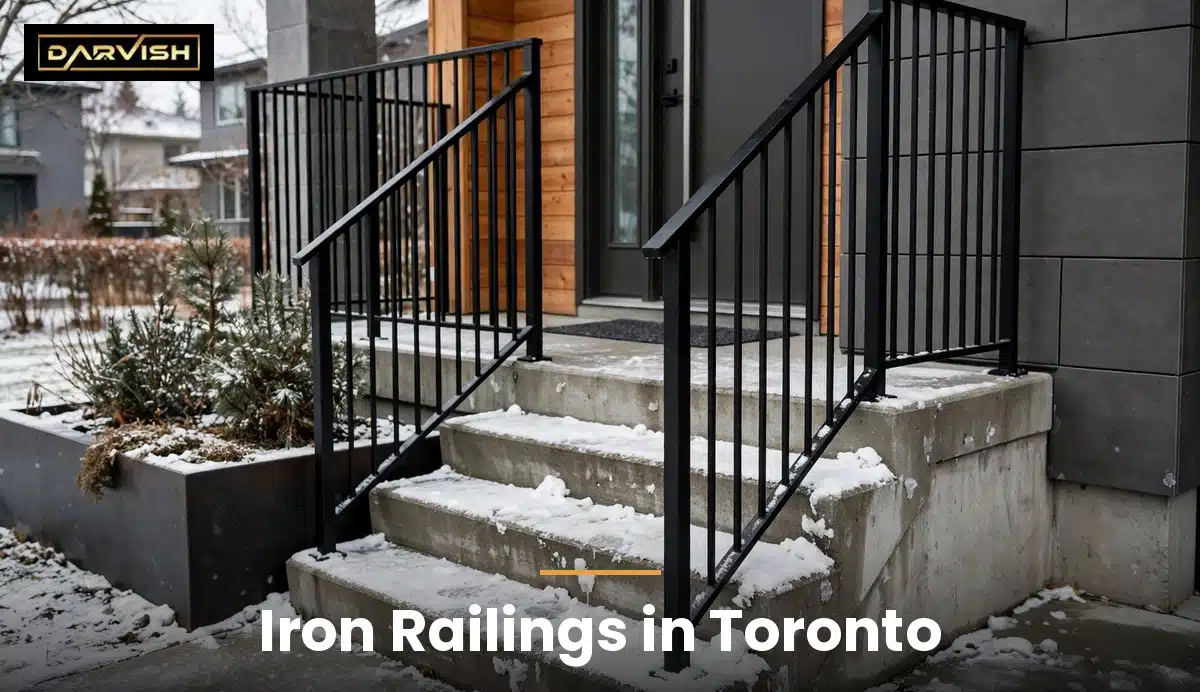
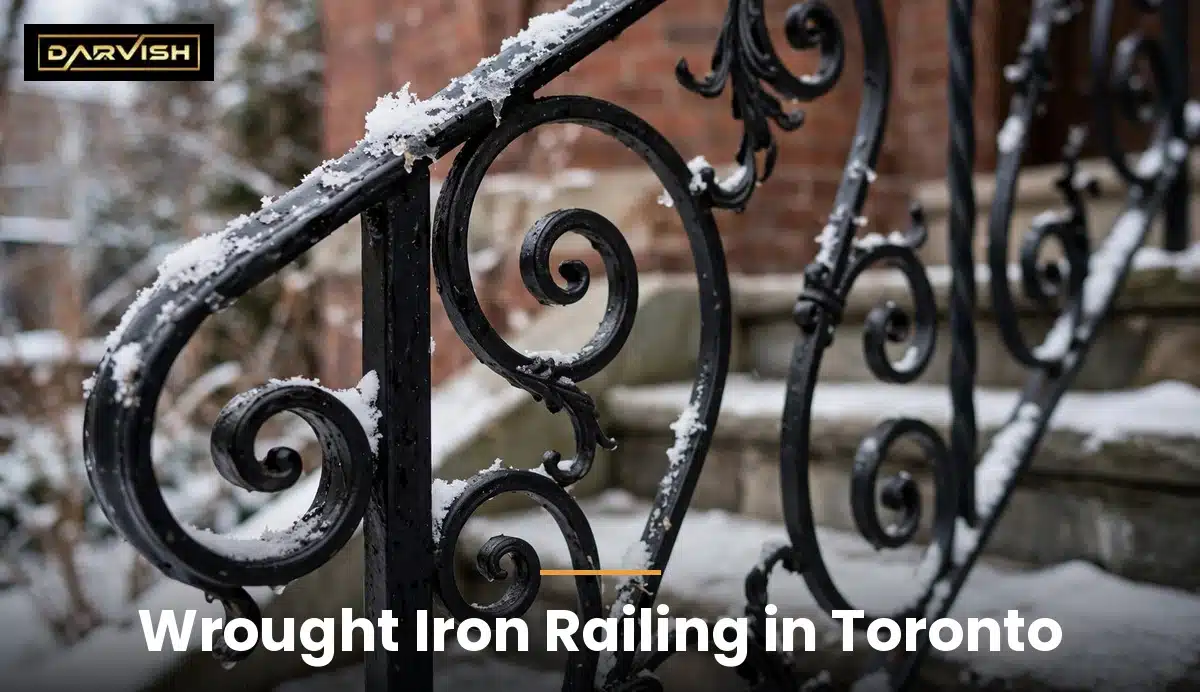
Iron railings are widely used for outdoor railings across Toronto because they offer exceptional structural stability and longevity, and the wood vs iron railings question is usually answered here, in the iron section, by homeowners who have already replaced a wood railing once. A wrought iron railing for outdoor stairs Toronto homeowners choose for a front entrance is the railing that has to work every day of winter without a second thought, and iron does that when it is fabricated right and coated right. The wrought iron railings for outdoor stairs we install most often are the ones with a powder-coated finish and a slim profile. Iron stair railings Toronto winters throw everything at — snow load, ice, salt, forty-degree swings — hold their shape, hold their grip, and hold their line.
Why Iron Is Often the Safer Long Term Choice
- Excellent resistance to snow loads and temperature changes: iron does not swell, shrink or warp with the weather, so the railing stays square and the balusters stay where they were put.
- Long lifespan with proper powder coating or galvanization: a coated iron railing can outlast the staircase it is attached to, and the coating is the whole secret — it is what stands between the iron and the salt.
- Minimal movement during freeze-thaw cycles: iron expands and contracts so little that the joints stay tight all winter, which is why an iron railing feels solid in February and a wood railing often does not.
- Strong grip and enhanced safety in icy conditions: an iron handrail is cold, but it is also firm and predictable under a gloved hand, and it does not get slick the way a wet wood handrail does.
Metal railings for stairs Toronto families rely on are usually iron for exactly this reason: the railing is a safety device first and a design feature second, and iron is the material that treats safety as the priority. In areas like stairs railings in North York, iron is often preferred for its durability, compliance, and modern appearance.
Things to Consider
- Higher upfront investment compared to wood: iron costs more to buy and more to install, because it is fabricated to order and installed by specialists — but the cost is paid once, not every year.
- Requires professional fabrication and installation: an iron railing is not a weekend project, and a badly fabricated iron railing is worse than a good wood one, because the mistakes are welded in.
- Poor quality coatings can lead to corrosion over time: the coating is the railing’s only defence against salt, so a cheap coating is a false economy — ask what coating is used and how long it is guaranteed for.
A wrought iron railing for outdoor stairs Toronto winters will punish is only as good as its coating, so the question to ask is never “is it iron?” but “what is on the iron, and who put it there?” Iron stair railings Toronto winters punish hardest are the ones with a cheap coating — ask what coating is used and how long it is guaranteed for, before you sign anything. Best suited for: homeowners prioritizing safety, low maintenance, and long-term performance.
Wood vs. Iron Railings: Comparison at a Glance
The wood vs iron railings comparison is easier to judge side by side, so here is the whole argument in one table. Metal railings for stairs Toronto homeowners compare in showrooms usually look similar at first glance — the difference only shows up after three winters, and that is what this table is really measuring.
| Feature | Wood Railings | Iron Railings |
|---|---|---|
| Winter Durability | Moderate | High |
| Maintenance Needs | High | Low |
| Lifespan | Short to Medium | Long |
| Safety in Ice | Moderate | High |
| Design Flexibility | High | High |
| Long Term Value | Lower | Higher |
| Cost | Lower upfront | Higher upfront |
Read the table from the bottom up and the story is simple: wood asks less of your wallet today and more of your time every year after, while iron asks more today and almost nothing after. Neither row is wrong on its own — the wrong choice is the one that does not match how you actually live with the staircase.
Cost: Wood or Iron Railings in Toronto
Cost is where the wood vs iron railings decision usually gets made, and it is also where most homeowners get it wrong, because they compare the price on the day and forget the price over ten years. Outdoor stairs and railings in wood cost less upfront: the material is cheaper, the fabrication is simpler, and the installation is faster. Iron costs more upfront: the material is fabricated to order, the coating is applied in a shop, and the installation needs specialists. But the comparison does not end on the day the railing is installed. A wood railing needs sealing, staining or painting on a regular basis, and each round costs time or money — and skipping a round shortens the railing’s life. An iron railing needs almost nothing after installation, apart from an occasional check of the coating, and its lifespan is long. So the honest way to compare cost is not “which is cheaper to buy” but “which is cheaper to own for ten winters” — and on that measure, iron usually wins, even though it costs more on the first day. No dollar figures are given here on purpose: the price of a railing depends on the length, the design, the material grade and the site, and the only honest number is the one in a written quote for your staircase. For a wood-specific breakdown, see wood railing cost in Toronto.
Installation Quality Matters More Than Material
Even the best materials can fail if installed incorrectly, and the wood vs iron railings debate is meaningless if the railing is not anchored properly. Outdoor stairs and railings in Toronto sit on concrete that moves with the frost, so the installation has to be planned for the ground, not just for the railing. Experienced staircase contractors understand how to anchor railings properly below the frost line, allow for thermal expansion and contraction, meet load-bearing and safety requirements, and ensure long-term stability in extreme weather. Iron stair railings Toronto winters test hardest are the ones where the anchoring was done right, because the railing is only as strong as the concrete it is bolted to. This is why working with reliable stair companies Toronto homeowners trust is critical for both safety and compliance — and why metal railing installation should always be done by a specialist, not a general contractor. Metal railings for stairs Toronto homeowners install through a specialist last longer, because the specialist measures twice and welds once. A good installer will also tell you honestly when your staircase needs work before the railing goes on, instead of bolting a new railing onto a failing step. For a detailed breakdown, see staircase installation cost.
Safety Standards & Building Code Considerations
Outdoor stairs in Ontario must comply with current building code requirements, and the Ontario Building Code is the document that decides whether your railing passes inspection — not the showroom, and not the installer. The code covers minimum guard and handrail heights, load resistance and structural integrity, baluster spacing to prevent falls, and continuous and graspable handrails. Two figures from the code are worth knowing: a handrail must sit between 865 and 965 mm above the stair nosing, and a guard is required wherever the drop beside the stairs exceeds 600 mm. Recent enforcement has placed greater emphasis on fall prevention and exterior safety, especially for outdoor stairs exposed to winter conditions. Non-compliant railings can lead to failed inspections and costly rework — and a railing that fails inspection in November is a railing you cannot use all winter. A wrought iron railing for outdoor stairs Toronto inspectors see most often is the one that was built to the code from the start, because iron is fabricated to exact measurements in a shop, while a wood railing is often cut to fit on site, where measurements drift.
How to Choose the Right Railing for Your Home
There is no one-size-fits-all solution — the right choice depends on your priorities and environment, and the wood vs iron railings question is really four smaller questions. A wrought iron railing for outdoor stairs Toronto homeowners buy for a long-term home is a different decision from the one a homeowner makes for a house they plan to sell in two years.
- Do you prefer low maintenance or a natural wood aesthetic? If you will not seal a railing every year, do not buy wood.
- Is this a long-term home or a short-term investment? A long-term home rewards iron’s lifespan; a short-term home may not need it.
- How important is winter safety for your household? Children, elderly parents, and anyone with limited mobility need the railing that grips best in ice.
- Do you plan to integrate your outdoor stairs with future upgrades like glass railings or additional interior railings? Iron pairs naturally with glass; wood pairs naturally with wood.
Answer those four honestly and the material usually chooses itself. The mistake is choosing the material first and the priorities second.
Final Thoughts: Wood or Iron for Toronto Winters?
For most outdoor stairs, iron railings offer superior performance in Toronto’s harsh winters — but that sentence needs its qualifier, because well-built wood railings can still be a great choice when properly designed and maintained. The wood vs iron railings answer is not “iron always wins” but “iron wins for most homes, most winters, most households.” Iron stair railings Toronto winters cannot move, cannot warp and cannot rot are the safe default, and for a family home with children or elderly parents, the safe default is the right choice. But if you love wood, you will maintain it, and your staircase is sheltered from the worst of the weather, wood is a fair and beautiful choice. The real difference comes down to expert design, quality materials, and professional installation — and to the honesty of matching the material to the life you actually live. You can also see recent work and reviews on Darvish Inc on Google.
Ready to Upgrade Your Outdoor Stairs?
Darvish Inc. specializes in stairs and railings, including wood railings, iron railings, outdoor railings, and fully customized solutions across Toronto, North York, Richmond Hill, Markham, Vaughan, and Oakville. If you’re looking for a railing system that combines safety, durability, and design built specifically for Toronto winters, our team is ready to help. Contact us today to discuss your project and get expert guidance tailored to your property — and to see the custom staircases we have built for homes like yours across the GTA. Build it once. Build it right.
Frequently Asked Questions
▾Wood or iron — which is better for outdoor stairs in Toronto?
For most outdoor stairs in Toronto, iron is better, because the wood vs iron railings comparison comes down to winter: iron does not absorb moisture, does not warp in freeze-thaw cycles, and needs almost no maintenance after installation. Wood can still be a great choice when it is designed right, built with the right species, and sealed every year — but if the maintenance will not happen, iron is the honest answer.
▾Do wood railings last in Toronto winters?
Wood railings can last in Toronto winters, but only with regular maintenance: sealing, staining or painting every year or two, and prompt repair of any crack that lets water in. Outdoor stairs and railings in wood fail slowly — a baluster that moves, a joint that opens, a finish that peels — and each small failure is a sign the maintenance is behind. A sheltered staircase and a diligent owner can keep wood looking good for many years.
▾Is iron more expensive than wood for outdoor stairs?
Iron is more expensive upfront than wood, but it is usually cheaper to own over ten winters, because it needs almost no maintenance after installation. Metal railings for stairs Toronto homeowners price in a showroom often look similar at first, but the wood railing’s real cost includes every round of sealing, staining and repair over its life. The only honest number for either material is the one in a written quote for your staircase.
▾What is a wrought iron railing?
A wrought iron railing is a railing made from iron that is heated and worked into shape, usually with decorative scrolls or a classic profile, then coated — most often powder-coated — to protect it from rust. A wrought iron railing for outdoor stairs Toronto homeowners choose is fabricated to order in a shop, so every baluster and every joint is made to exact measurements, and the coating is applied before the railing ever sees salt or snow.
▾Can I mix wood and metal on the same staircase?
Yes — mixing wood and metal is common, and it is often the best of both: wood treads and a wood handrail for warmth, with metal balusters for strength and a slim profile. Iron stair railings Toronto homes mix with wood usually keep the metal where the weather hits hardest — the balusters and the supports — and the wood where the hand touches, so the staircase feels warm but behaves like iron in winter.
▾How often should wood railings be sealed in Toronto?
A wood railing in Toronto needs sealing, staining or painting every year or two. Skipping a year is how a five-year railing becomes a two-year railing.
▾Is an iron handrail slippery in winter?
An iron handrail is cold, but it is also firm under the hand — the page’s comparison scores iron higher than wood for safety in ice, and iron expands and contracts so little that the joints stay tight all winter.