


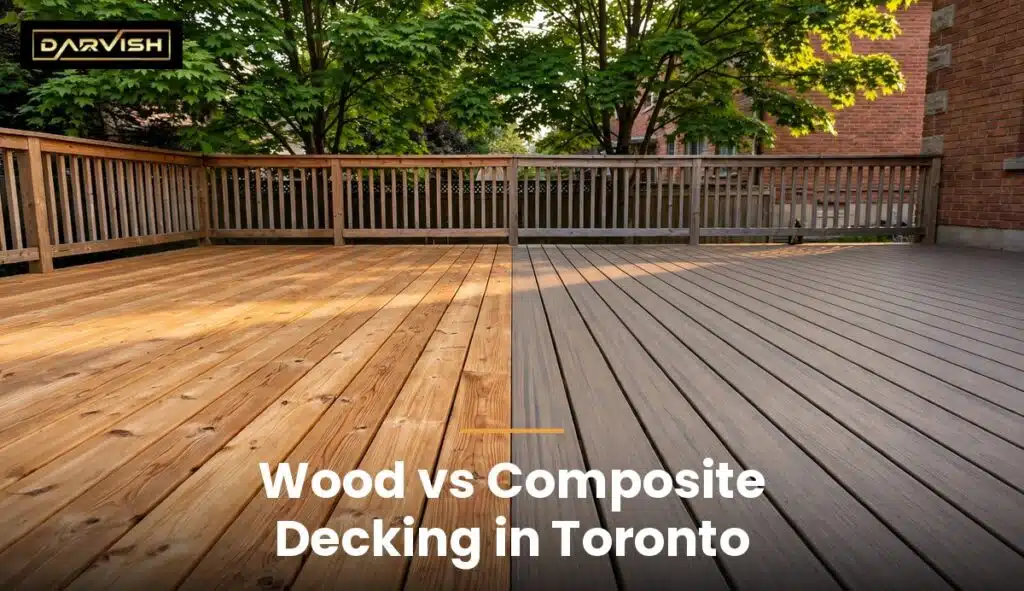
Choosing between wood vs composite decking is one of the most important decisions homeowners across the GTA face when planning an outdoor renovation. Both materials promise years of outdoor enjoyment, but they perform very differently once exposed to real life: cold Ontario winters, hot summer sun, family gatherings, and daily wear. For many households, the wood decking Toronto builders have trusted for decades still sets the benchmark, while the composite decking Toronto suppliers now stock has closed much of the gap on looks and convenience.
Rather than comparing the two materials in a single sweeping statement, this guide breaks the decision down using a clear, structured method that covers every factor that actually matters: composition, cost, long-term maintenance, climate durability, appearance, comfort, environmental impact, and resale value. By the end, you will see why, for the vast majority of homeowners in Toronto, North York, Markham, Richmond Hill, and Oakville, wood remains the smarter long-term choice — and where composite makes sense instead.
What Are Wood and Composite Decking Actually Made Of?
Wood decking is exactly what it sounds like: solid lumber, most commonly pressure-treated pine, cedar, or a premium hardwood, milled into deck boards. The wood is a single, natural material from root to surface, which is why it can be sanded, stained, repaired, and refinished almost indefinitely.
Composite decking is a manufactured product, typically a blend of wood fibers and recycled plastic, pressed together and capped with a protective plastic shell. It is designed to mimic the look of wood without being wood. This single distinction, a natural material versus an engineered product, explains almost every difference described below.
That distinction also shapes the wood vs composite decking debate in a practical way: with wood, what you see is what you get, and any board can be replaced with a matching piece of lumber from any yard. With composite, you are buying into one manufacturer’s system, so the colour, profile and fastening method all come from the same catalogue.
Upfront Cost
Wood decking is generally the more budget-friendly option at the time of installation. Lumber costs less to produce and install than the multi-layer manufacturing process behind composite boards. Composite decking typically carries a noticeably higher price per square foot before a single screw is driven, since you are paying for the engineering that makes it low-maintenance. For homeowners working with a defined renovation budget, wood usually leaves more room to invest in better railings, lighting, or a larger deck footprint.
The gap is widest at the top end: premium composite boards with capped shells and hidden fasteners cost the most, while pressure-treated pine sits at the other end of the range. Between those two poles, cedar and mid-range composite overlap more than most homeowners expect, which is why the wood vs composite decking decision is rarely about the cheapest board alone. And when you compare what composite decking Toronto retailers list this season, the installed price also depends on the frame, the fasteners and the railing you pair it with.
Long-Term Maintenance and Lifetime Cost
Composite decking is marketed heavily on low maintenance, and it is true that it does not need annual staining. However, low maintenance does not mean no cost. When a composite board cracks, fades unevenly, or gets damaged, the entire board often needs to be replaced, and matching the original color years later can be difficult since manufacturers regularly discontinue colorways.
Wood decking does need periodic cleaning and a fresh coat of stain or sealant every few years, but this maintenance is simple, inexpensive, and something most homeowners can do themselves. Repairs are also straightforward: a single damaged board can be replaced in minutes without disturbing the rest of the deck.
Over a decade or more, those small differences add up. A wood deck asks for a weekend of work every few years; a composite deck asks for almost nothing until something breaks, and then the repair is bigger. Homeowners who compare what composite decking Toronto installers quote alongside a wood quote should ask what a single replacement board costs in each material, because that figure tells you more about lifetime cost than the brochure does.
Durability Through GTA Winters
Ontario winters put any outdoor structure to the test, with freeze-thaw cycles, road salt, and heavy snow loads year after year. Properly treated wood flexes naturally with temperature swings and ground movement, which is one of the reasons wood-framed decks have remained the standard structural choice across Toronto, North York, Markham, and Richmond Hill for decades.
Composite boards, by contrast, can become more brittle in extreme cold, and because they are rigid, they are less forgiving of the natural shifting that occurs in frozen ground. With correct construction and seasonal care, a quality wood deck can perform reliably through harsh Canadian winters for many years.
The current Ontario Building Code sets out the rules for guard heights, stair dimensions and structural loads that apply to any deck or exterior stair in Ontario, and a deck that meets those rules is inspected against the same standards whether its boards are wood or composite. Before finalising a design, it is worth reviewing the code requirements for your project so there are no surprises at inspection.
That flexibility is also why the wood decking Toronto contractors install most often is still pressure-treated pine and cedar: both move with the seasons instead of fighting them, and both can be repaired board by board after a hard winter.
Appearance and Customization
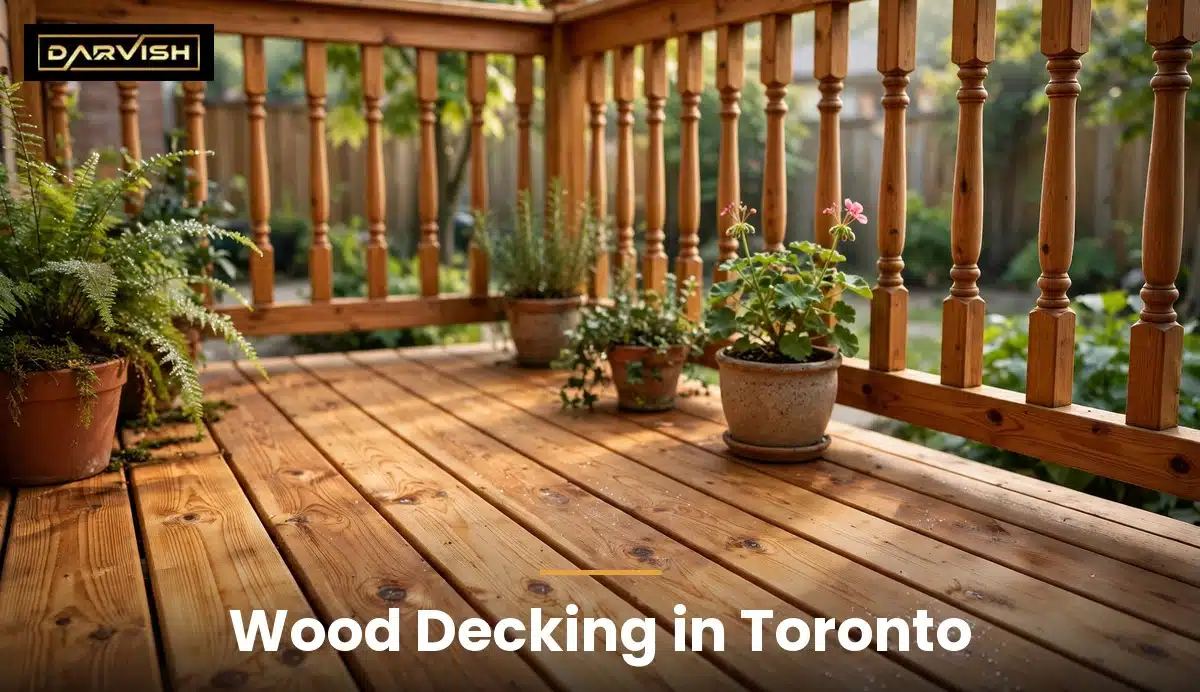
Wood offers something composite simply cannot replicate: real grain, real texture, and a finish that can be changed at any time. You can stain wood lighter or darker, match it to a new exterior color scheme, or let it weather naturally into a soft silver-grey patina that many homeowners love.
Composite decking comes in a fixed set of factory colors that cannot be altered once installed. If your taste changes or you want to update your home’s exterior down the road, the deck itself cannot adapt with you the way wood can.
The same logic applies to the railing around the deck: a wood deck with glass railings keeps the view open and lets the grain do the talking, while a solid composite rail can close the space in. Choosing the decking and the railing together, rather than as two separate decisions, is what makes the finished outdoor room feel designed rather than assembled. The same choice appears at the balustrade, where composite vs wooden balustrades set the tone for the whole deck.
When homeowners weigh wood vs composite decking on looks alone, wood usually wins the first impression and composite wins the catalogue photo. The honest test is to look at both materials after five Toronto winters, not on the day they are installed.
Comfort and Safety Underfoot
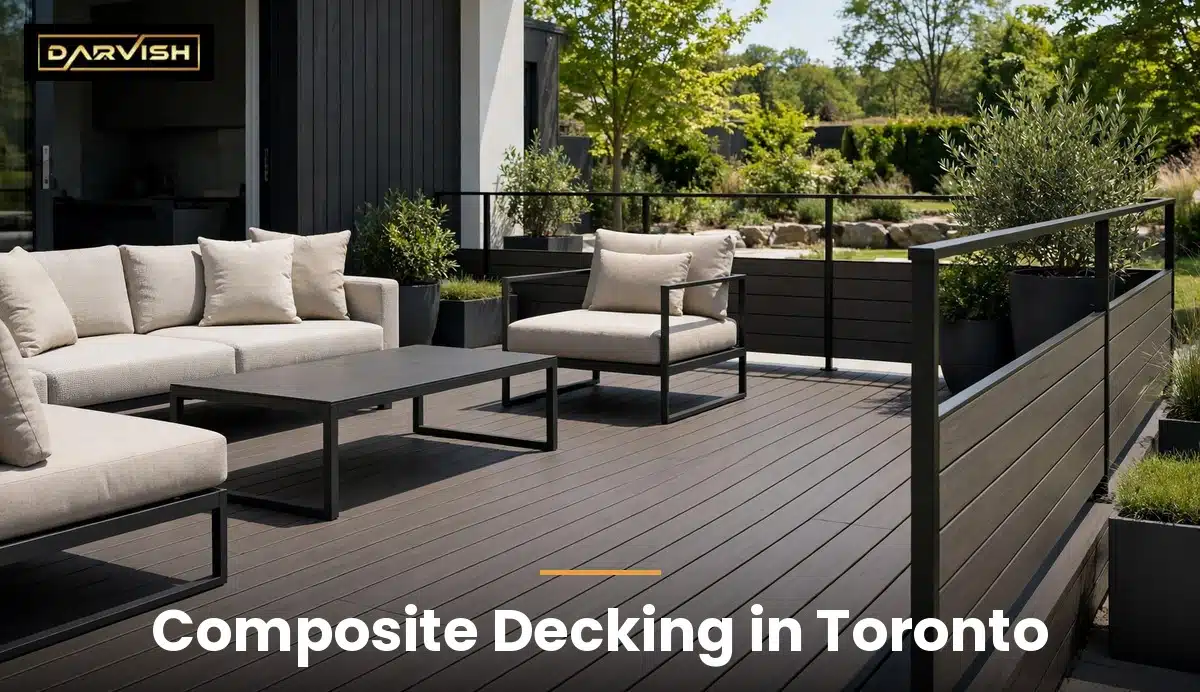
On hot summer days, dark composite boards can absorb significant heat and become uncomfortably warm to walk on barefoot. Wood stays noticeably cooler in direct sunlight, which matters for families with young children or anyone who spends long afternoons outdoors. Both materials can be finished with slip-resistant textures, but wood’s natural surface generally provides reliable grip without the artificial texture coatings some composite products rely on.
That heat difference is easy to test on the first hot weekend of the year, and it is one of the reasons families with small children lean toward wood. A deck that is too hot to walk on barefoot is a deck nobody uses in July, whatever its maintenance schedule says.
The same comfort question comes up at the railing: composite vs wooden balustrades feel different in the hand, and the choice changes how the deck looks from the garden as well as from the house. A wooden balustrade warms to the touch and matches a wood deck board for board, while a composite balustrade stays uniform and needs no refinishing.
Environmental Considerations
Wood sourced from responsibly managed forests is a renewable, biodegradable material with a far smaller manufacturing footprint than composite. Composite decking does reuse recycled plastic, which is a genuine benefit, but the boards themselves are difficult to recycle again at the end of their life and are ultimately a petroleum-based product. For homeowners who weigh environmental impact in their decision, sustainably sourced wood is generally the lower-impact choice.
The comparison is not one-sided: keeping plastic out of landfill is a real benefit, and a composite deck that lasts thirty years without a stain can has its own footprint story. But when the boards finally come off, wood returns to the soil and composite goes to landfill, and that end-of-life difference is part of the wood vs composite decking decision too.
Resale Value and Curb Appeal
Real estate agents and buyers consistently respond well to natural materials. A well-built wood deck, especially one finished with quality railings, signals genuine craftsmanship rather than a manufactured product. Pairing a new wood deck with matching Wood Railings creates a cohesive look from the stairs to the outdoor living space, the kind of detail that stands out during a home showing.
Many homeowners renovating their exterior also choose to continue the same warm, natural aesthetic indoors with matching Interior Railings on their staircase, creating one consistent design story throughout the home.
Buyers notice the railing as much as the decking itself, and wood vs composite railing systems are one of the first things a visitor touches when they step outside. A wood decking Toronto buyer recognises at a glance reads as cared for, while a tired composite deck with faded boards can drag down an otherwise strong showing.
Wood vs Composite Decking at a Glance
The table below puts the whole wood vs composite decking comparison on one page, so you can see where each material wins before you read the verdict.
| Factor | Wood Decking | Composite Decking |
|---|---|---|
| Upfront Cost | Lower | Higher |
| Maintenance | Periodic staining, easy DIY upkeep | Low routine upkeep, costly repairs |
| Repairability | Replace a single board easily | Often needs full board replacement |
| Winter Performance (GTA) | Flexes naturally, proven long-term | Can become brittle in extreme cold |
| Customization | Fully stainable, ages naturally | Fixed factory colors only |
| Heat in Summer Sun | Stays cooler underfoot | Can retain significant heat |
| Resale Appeal | Valued as an authentic, premium material | Practical but less distinctive |
Wood vs Composite Railing Systems: What Changes on the Railing
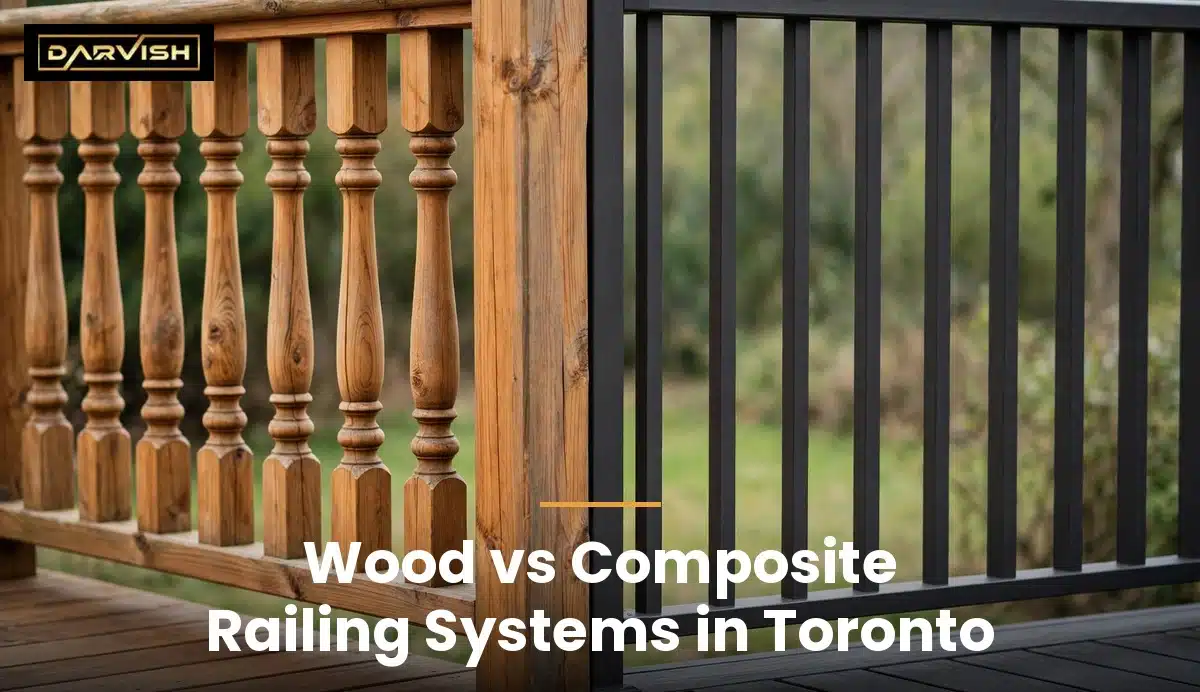
The decking decision does not stop at the boards. Wood vs composite railing systems behave differently too: a wood railing can be sanded and restained to match a new deck colour, while a composite railing holds its factory colour for life and cannot be refinished. If you plan to restain the deck in five years, a wood railing follows along; a composite railing does not.
Material choice matters at the railing as well. Some homeowners pair a wood deck with metal railings for a slimmer profile and a longer span between posts, which keeps the view open without giving up strength. The railing is the part of the deck everyone touches, so it deserves the same attention as the boards underfoot.
Balustrade style is where the two materials show their character most clearly. Composite vs wooden balustrades is a real design choice, not just a maintenance one: wooden balusters can be turned, tapered or spaced to suit the house, while composite balusters arrive in fixed profiles that suit modern homes best. Either can meet the code, but they do not look the same doing it.
How to Choose Between Wood vs Composite Decking
Start with how you actually use the deck. If it hosts barefoot children, summer dinners and a barbecue, wood’s cooler surface and easy repairs matter more than a stain-free promise. If the deck is a showpiece you rarely walk on barefoot, composite’s uniform finish may suit you better. A deck you use every day deserves a different material than a deck you only look at from the kitchen window.
Then check what is available locally. The composite decking Toronto yards stock this season and the wood decking Toronto lumberyards carry are both worth pricing in person, because installed cost depends on the frame, the fasteners and the railing as much as on the boards themselves.
Finally, decide the railing before you order the boards. Wood vs composite railing systems set the look of the whole outdoor room, and ordering both from the same plan avoids the mismatched-deck problem that shows up in so many resale photos.
Final Verdict: Why Wood Decking Is the Better Investment
When you weigh every factor side by side, cost, repairability, climate performance, appearance, and long-term value, wood comes out ahead for most GTA homeowners. Composite decking can work well for buyers who want a single, predictable surface and are willing to pay more upfront for slightly less seasonal upkeep, but it cannot match the character, flexibility, and repairability of real wood.
If you are planning a new deck or upgrading an existing one and want a material that ages beautifully, repairs easily, and complements the rest of your home, wood decking paired with a custom wood railing system remains the most reliable choice across Toronto, North York, Markham, Richmond Hill, and Oakville.
In the end, the wood vs composite decking question comes down to what you want the deck to do for you. If you want a surface that can be repaired, refinished and restyled over decades, wood is the answer; if you want a surface you never have to think about, composite earns its premium. Either way, the deck should feel like part of the house, not an afterthought — and homeowners who carry the same thinking indoors often finish the project with custom staircases that match the deck’s warmth step for step. The choice between composite vs wooden balustrades is part of the same decision, and it is worth making deliberately rather than by default.
Ready to Build Your Deck?
If you are ready to plan a new deck or upgrade the one you have, talk to a contractor who builds both materials and can show you finished examples of each. You can browse Darvish Inc on Google to see examples of completed work before booking a consultation, and ask how wood vs composite railing systems would look on your home specifically. For many Toronto homeowners, the composite decking Toronto market offers a strong low-maintenance option, but the final call should follow a site visit, not a brochure.
A short site visit settles the wood vs composite decking question faster than any amount of reading, because the right answer depends on your sun exposure, your framing and how your family uses the space. Contact Darvish Inc. today to schedule a professional consultation on your outdoor project.
Frequently Asked Questions
▾How long does wood decking last in Toronto?
A well-built, properly maintained wood deck in Toronto typically lasts for decades, because boards can be sanded, restained and replaced one at a time. The wood decking Toronto homeowners keep longest is usually pressure-treated pine or cedar with a sound frame underneath, and a deck that is cleaned and sealed on schedule outlasts one that is ignored.
▾Is composite decking worth the extra cost?
It can be, if you value a uniform finish and minimal seasonal work and you plan to stay in the home long enough for the higher upfront cost to pay off. Ask for an installed quote for both materials on your exact deck size, and compare composite against wood on the same frame before you decide.
▾Does composite decking get hot in summer?
Yes, dark composite boards can become uncomfortably warm in direct summer sun, while wood stays noticeably cooler underfoot. If your deck faces south or west and your family walks barefoot, that difference alone is worth weighing.
▾Can I mix wood decking with composite railings?
Yes. Many homeowners pair a wood deck with composite railings, or a composite deck with wooden balusters, and the combination works well when the colours are chosen together. The composite vs wooden balustrades decision is about looks and touch as much as maintenance, so see both in person before you commit.
▾Do I need a permit for a new deck in Toronto?
Most deck replacements in Toronto need a permit when the structure changes, and any deck attached to the house is usually reviewed for guards, stairs and balustrade spacing. Your contractor should confirm what applies to your project before work starts.